
Blessed Alban Hefin ❣️
The summer solstice is the time of greatest brightness for us—and it is known as a festival of joy. In a way, it is the most outwardly directed of the eight festivals. And just as the landscape around us basks in colorful and fragrant splendor, we also celebrate the strength and power of the sun and the richness of the earth.
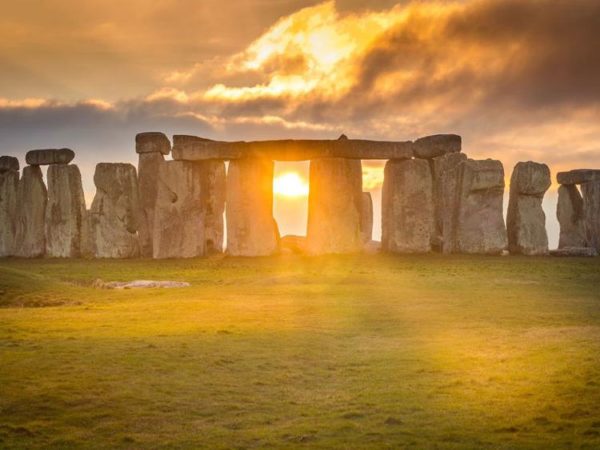
Exactly between Beltane and Lughnasadh lies Alban Hefin, the summer solstice at the peak of the sun's influence on the earth. The spiral of the year has stretched to its outermost point and the hours of light last longer than ever. After June 21 or 22, the power of the sun begins to wane and the days grow shorter. The sun has reached its northernmost point on the horizon (at sunrise and sunset) and now begins its long journey south, which ends at Alban Arthan, the winter solstice, in mid-December. On the southern hemisphere, Alban Hefin falls on December 21 or 22, when the sun rises and sets at its southernmost point on the horizon.
In Cornwall and Wales, girls and boys adorned with flower garlands went to dance around the great fires. Young men twirled burning logs above their heads to form sun wheels. They balanced burning barrels on poles or undertook challenges of courage, such as jumping through the flames. Perhaps they also wanted to encourage the grain to "jump" upwards as well. When the flames had burnt down, the dancers took each other’s hands and ran through the glowing embers. They were careful not to break the chain, as that would bring bad luck. It was believed that the ashes of these fires had magical powers. The farmers carefully gathered them to scatter on the fields or in the stables. The ancient customs of the bonfires persisted until today and are still widespread in Cornwall, thanks to the efforts of the "Old Cornwall Society" to keep the old traditions alive. On Midsummer’s Night, every hill in Cornwall glows like a signal fire visible for miles. It is as it was in olden days; in some towns, long lines of dancers winding in the ancient serpent dance through the streets.
In the Irish county of Limerick, people would walk in long lines to the hill of the fairy queen Áine. Her name means "brightness." She was probably once a sun goddess. To ensure a good harvest and healthy livestock, people set bundles of straw and hay on fire, called "cliars," which they swung over the fields and grazing animals. As soon as the great fire was lit on the hill, Áine came out with her company to the festival. In the 19th century, a few girls had stayed up on such an occasion to watch the cliars when Áine suddenly appeared among them. She thanked them for the honor shown to her, but pointed out that they should now go home, as her friends from the Otherworld wanted the hill for themselves. Some mortals looked through her ring and it seemed to them as if fairies and elves teemed all over the hill, made visible by its magical powers.
The summer solstice was one of the three spirit nights of the year, with Beltane and Samhain being the other two. Fairies and spirits were on the move and could easily be seen by those whose receptivity made the veil between worlds unusually thin. This was also an appropriate time to gather magical and healing herbs: fern seeds collected on the evening of the summer solstice could make one invisible, elderberries warded off curses, yarrow, vervain, and ironwort were hung in special places of the house as protection against the evil eye and death. Above all, it was the time to pick St. John's Wort. The golden star-shaped flower was the first of the herbs picked on Midsummer's Eve. Called the "blessed plant" in Wales, it was known in Celtic lands to bring peace and prosperity to homes, abundant harvests, and health to livestock. Due to its protective powers, it was thrown into the solstice fires in Scotland and hung over the doors of houses and farms. The belief holds that these magical plants were filled with the sun's energy at its peak. This energy now transforms into a green blessing for the human world.
This time is known in druidic tradition as Alban Hefin—"the light of summer" or "the light of the shore." At Alban Hefin, the rise of the sun that was born at Alban Arthan is complete. The winter solstice was a time of mourning for the death of the old year and the diminishing of light. Then the sun child, Mabon, was born and by Alban Eilir, the spring equinox, he had already fought with the darkness for dominion over the herds. Now, at the summer solstice, he has decisively won and pushed back the darkness to just a few hours. Therefore he is now the victor and in the prime of his power. But here, too, the lesson of contradictions is embodied—for in reaching his peak, he has also sown the seed of his downfall. From this point of the year, the descent begins towards the shortest day—Alban Arthan; as it is said in Taoist tradition: "When Yang reaches its peak, it becomes Yin; when Yin reaches its peak, it becomes Yang."