
Dualism at once
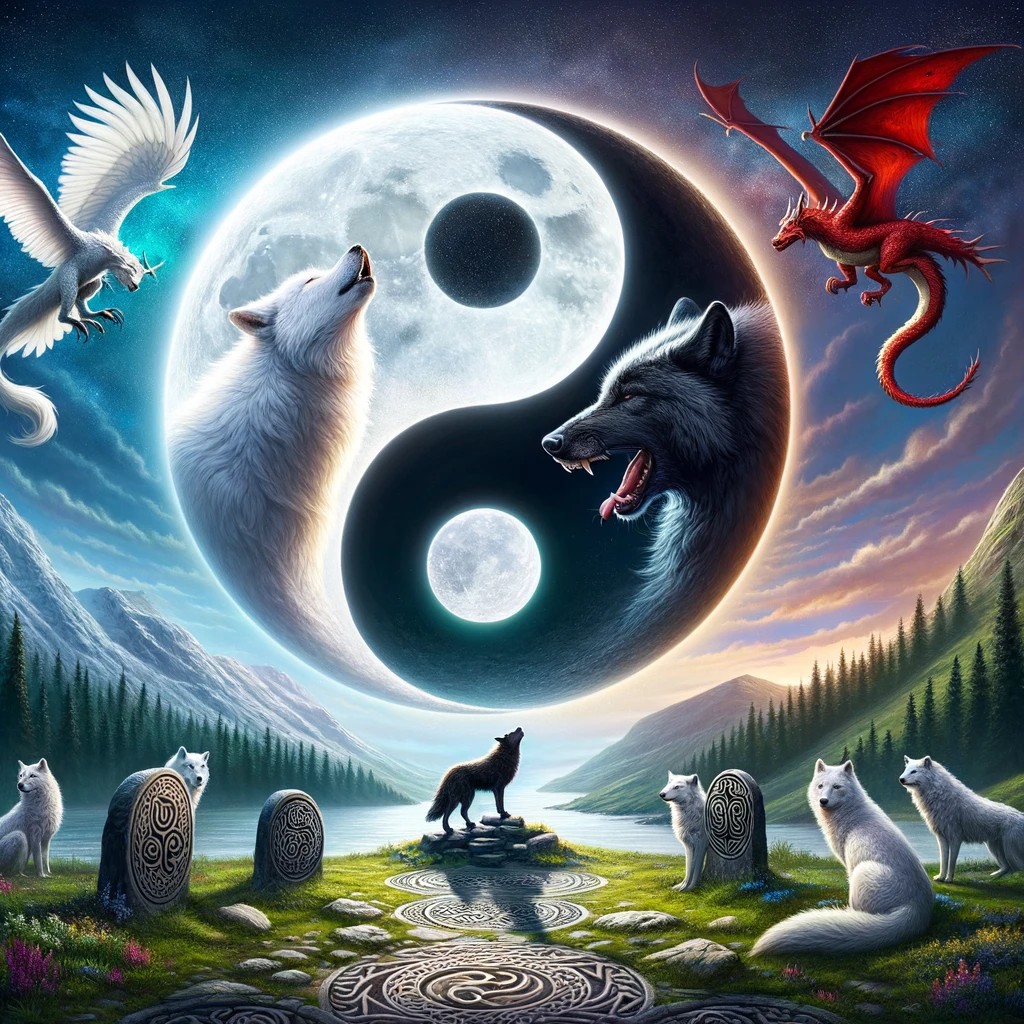
The image before us is rich in symbolism, a visual representation of the principle of duality, which states that two opposing forces are connected and can be complementary within a greater whole. At the center is the Yin-Yang symbol, an ancient Chinese concept that describes how seemingly opposite forces in the natural world can actually be complementary, interconnected, and interdependent, giving rise to each other through their interplay.
This duality is reflected in the artwork in the forms of the creatures and their postures. The white and black wolves, one howling in the light and the other growling into the darkness, represent the light and shadow aspects of existence. They are not merely animals but symbols, archetypes representing the dual nature of reality – life and death, growth and decay, wisdom and instinct. The presence of the dragons, creatures often associated with power, wisdom, and a dual nature of creation and destruction, further emphasizes these themes.
The moon depicted in the sky and its phases symbolize constant change and the cyclical nature of life, reflecting the transient nature of existence in which opposites are in constant flux yet maintain a universal balance. The rune stones standing silently between the wolves point to a deep-rooted connection to the earth and ancient wisdom acknowledging the necessity of balance between opposing forces.
This duality is inherent in all things. It teaches us that every action has an equal and opposite reaction, that every joy carries the seed of sorrow within it, and that every beginning will eventually find its end. However, this is not a cause for despair but a call to embrace the totality of experience and learn from both light and darkness. By understanding and accepting the dual nature of all things, we find harmony and balance in our lives and in the universe as a whole.